
Traveling internationally with your pets requires a proper set of plans, or otherwise you will end up with unnecessary costs in the destination country. Including microchipping, the most important thing is titer testing, which ensures that all your pets meet all the health and vaccination requirements of the destination country. One of the key parts of this process is titer testing; it’s a crucial step for the pets, especially if you are traveling to a country with strict animal rabies control rules and regulations.
In this blog you will see why titer testing is important and why it’s necessary and what you need to know for international travel with your pets.
What is titer testing?
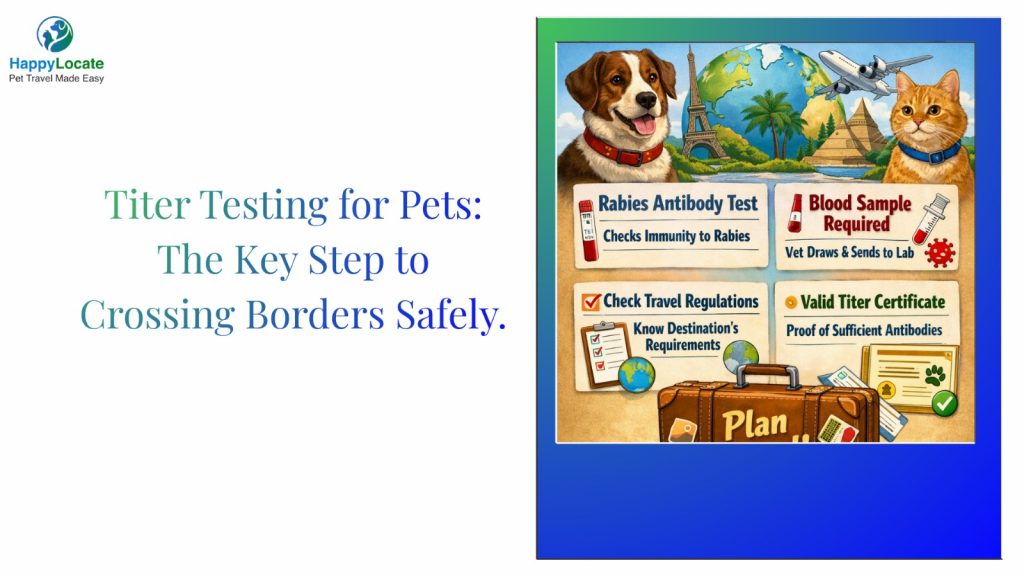
It is also known that rabies antigen-antibody testing, which will always estimate the level of antibodies in your pet’s blood, determines whether there is sufficient immunity against rabies. This test does not vaccinate or treat your pets, but it confirms whether primary vaccination is efficient or not.
It’s regularly required for international pet travel; many countries want proof of the pets’ nontransmission of rabies certificate.
Why the titer testing is important for cross-border travel.
Not all countries require titer testing for incoming pets, but major rabies countries mandate the rabies titer test. The example includes the European Union, New Zealand, Australia, and Japan.
These countries will mainly focus on protecting humans and animals from contagious diseases like rabies by ensuring that pets from other countries have the proper immunity. A vaccination certificate is not always enough; some pets will not have essential immunity after the rabies vaccination. In that case, the titer test provides the major scientific proof of the vaccination that worked.
If your pets fail the titer test, authorities may quarantine them, turn them away at the border, or even send them back to your country of origin.
When should we administer the titer test?
Authorities decide the timinig of titer test, and it may vary from country to country. Here are some general guidelines.
You should wait for one month after a pet’s rabies vaccination before doing the titer test. This allows your pet’s immune system to develop the antibodies against rabies.
Pre-travel planning: Many countries require the titer test 90 days before travel. That means that you are planning to move in January, so prepare in October.
Some countries will accept the process of validity; for example, the European Union typically accepts the positive record of a titer test as long as the rabies booster dose is up to date.
Always do the proper check of what the requirements are for the destination country via their official website. or consult the best relocation service, like HappyLocate.
Many pet owners find it confusing how the test is done
The process is simple; here are the steps.
Visit the veterinary doctor for titer testing. Professional vets will draw the blood sample of your pets and send it to a government-approved laboratory, such as those recognized by the European Union, which can process the travel-valid test.
Wait for the report: It typically takes 2-3 weeks to get the report, which depends on the lab and timings.
Check for the adequate level of antibodies: To get approved, your pet’s rabies antibody level must usually be greater than 0.5 ml. If the pet’s antibody falls below this limit, then your pet may need another shot of the booster dose.
Which pets do veterinarians usually prefer for titer testing?
The titer tests are most commonly required for the dogs and the cats, but some countries will mandate them for the other animals as well. The puppies and kittens should be old enough to receive the rabies vaccination and wait one month before testing, which affects the travel timings.
The tips for the travel if you are moving internationally
Start as early as possible. Always start planning pet travel 90 days before the departure dates to have some time for the vaccination. testing and paperwork.
Keep detailed records. Always keep the copy of all health records, vaccination titer tests, and microchipping records in the files to avoid the unnecessary complication during the time of the transits.
Work with professionals: If you are relocating for the first time, always choose the best relocation company, like HappyLocate, or vet destination rules and regulations.
Cost of titer testing
The cost of the titer test varies between 100 USD and 200 USD, which will vary depending on the vet clinic and country and region. This covers the cost of drawing the blood and sending it for laboratory testing. While it looks expensive, avoid the denial entry and avoid the cost of the return from the destination country.
Check out our latest blog:
Microchipping: A must-have ID for a pet to travel across a border.
Pet Travel Guide: How to Navigate Seasonal Risks
Your Furry Friend Is Sick While traveling.
The Pet Leash Essentials for Travel