
Yes, brachycephalic (snub-nosed) breeds can travel by air under special consideration because they are more prone to breathing difficulties than other pet breeds. Their shorter airways can make it harder for them to control their body temperature and breathing efficiency, especially during the pet’s anxiety situation, such as air travel.
The pet parent should go through the airline’s policies carefully and consult a veterinarian before planning for international travel with brachycephalic (snub-nosed) pets.
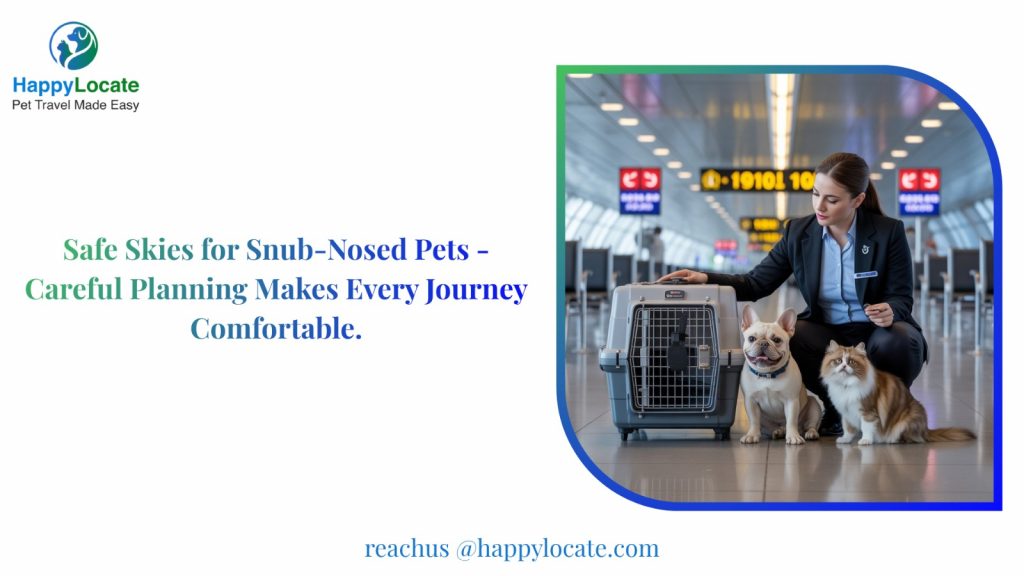
What are brachycephalic (snub-nosed) pets?
The snub-nosed breed has a shorter skull and flattened facial structure. The most common examples that are included.
Dogs
- Pug
- Bulldog
- French Bulldog
- Boxer
- Boston Terrier
- Shih Tzu
Cats
- Persian
- Himalayan
- Exotic Shorthair
These breeds may be restricted due to unique respiratory anatomy.
Why are brachycephalic (snub-nosed) dogs considered to be a higher risk during air travel?
Sun-nosed breeds can experience the following difficulties:
- Breathing issues.
- Increasing heat sensitivity.
- Decreased ability to cool by themselves.
- Anxiety-related breathing complications.
- Oxygen imbalance during travel.
For these reasons, most of the airlines have specific policies regarding the snub-nosed breeds.
Do airlines allow brachycephalic (snub-nosed) pets?
Some airlines allow the brachycephalic pets under certain conditions, while others may restrict them completely.
The airlines’ policies may involve:
- Seasonal journey restrictions.
- Temperature restriction.
- Breed-specific policies.
- Additional creative needs.
- exceptional cargo transport restrictions.
These are the policies that are substantially the same between airlines and the chosen routes.
How can pet parents improve the quality of travel safety?
Before flight travel, the owner must do the following:
Get veterinary health assessments.
You should get the veterinary health certificate that determines whether the pet is fit to travel, and they will identify if your pet is facing some respiratory issues.
Choose appropriate travel conditions.
Whenever it’s feasible:
- Try to select direct flights.
- Avoid pet travel during severe weather conditions.
- Decrease the journey timings.
- reduce the unnecessary stopovers.
The crates that should meet IATA guidelines
The crate that you choose should:
- Should allow your pets to stand comfortably.
- Your pet must have adequate ventilation.
- Should meet IATA specification.
- And should allow unblocked airflow.
Keep the pets calm.
Pet anxiety can worsen the breathing risks. You must place the familiar blankets or bedding, and proper pet crate training helps pets feel more comfortable during the journey.
Are the snub-nosed breeds safer in the cabin or cargo hold?
Airlines’ regulations may vary, but most of the experts state that pet travel in the cabin can be safer because pet owners can supervise the pets closely.
However, the suitability will depend on the following:
- Airline regulation.
- Pet size.
- Host country needs.
- Cabin pet policies that refer to the airlines.
The owner must confirm travel options directly with specific airlines.
Should pet sedation be used during air travel?
Tranquilisation must be taken into consideration when advised by a veterinarian.
Sedatives that affect the following:
- Breathing risks.
- Heart rate variation.
- Balance.
- Body temperature variation.
These effects may increase the risk during air transportation.
When should pet owners avoid air travel?
You postpone your pet relocation if a pet:
- Has existing respiratory issues.
- If your pets have gone through surgery or are recovering from surgery.
- Shows any sign of breathing distress.
- if your pets are not medically fit to travel.
- Faces the extreme weather conditions.
You must visit the veterinarian for the proper timing because they will provide the safest timing for the pet’s travel.
What are the precautionary measures that should be taken before moving?
The important steps that take place are:
- You must schedule the veterinary examination before travel.
- You must confirm the airline policies regarding the breed.
- Complete the travel documentation.
- You must provide the crate training for pets at least one month before moving.
- Prepare the temperature-controlled transportation.
- Must supervise the pets’ health before departure.
Early preparation helps reduce the travel risks.
With the right measures, brachycephalic (snub-nosed) animals are able to move by air quite successfully. These animals require special consideration due to their sensitivity when it comes to breathing problems; thus, it is advisable to visit a vet, be keen on the airline’s instructions, and consider other factors that will make sure the animal is comfortable during the journey.
Check out our latest blogs:
How Much Does International Pet Relocation Cost?
Pet Passport: Do Dogs or Cats Need One for International Travel?
Which Countries Have the Strictest Pet Import Rules?
Check out our social media page of pet relocation